
Microorganisms around us · 2 min read
Introduction
Listen to this lesson
A calm voice reads the lesson aloud
Tap any word for its meaning, or to have that part explained further.
Introduction to Microorganisms
Small living things are everywhere and they do a lot of work to keep our world moving and healthy.
Micro-organisms make up a significant part of the planet's living material and play an important role in maintaining the Earth's ecosystem.
These tiny living things are very important for the balance of life on Earth.
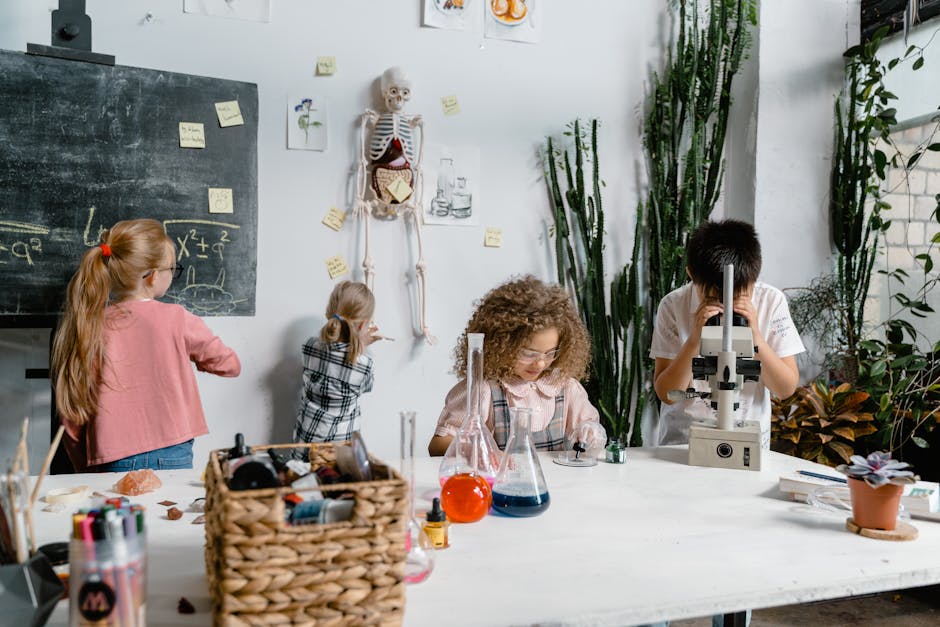
Microbes are so small that you cannot see them with your naked eyes unless you use a special machine.
Micro-organisms, often referred to as microbes or germs, are living things that cannot be seen without the aid of a microscope.
This means if you do not have a microscope to make them look bigger, you will not see these germs.
Some of these small things live alone as one body, while others live together in groups.
They are microscopic organisms that can exist as single cells, multiple cells, or clusters of cells.
Whether they are just one cell or many cells joined together, they are all still very tiny.
Microbes are everywhere in nature and they help us in many ways like in making food or medicine.
Micro-organisms are found throughout nature and are beneficial to life in many ways.
Even though they are small, they do a lot of good things for humans and animals.
Even though many are good, some of these tiny things can make people very sick.
However, some microbes can cause serious harm to health.
This is why we call some of them germs, because they bring diseases.
Where to find Microorganisms
Microbes live in every place you can think of, like inside your belly, in the dirt, or inside water.

They exist in various environments, including water, air, soil, and the surfaces of objects, as well as on and inside living organisms.
You can find them on your skin, in the air you breathe, and even on your school desk.
The wind can carry these tiny living things from the ground high up into the sky.
Micro-organisms can be carried by air currents from the Earth’s surface to the upper atmosphere.
They travel through the air to reach very high places where birds fly.
Microbes like to stay in places where they can find food, water, and where the place is not too hot or too cold.
They tend to thrive in places where there is food, moisture, and a suitable temperature for their growth.
Once they find food and a damp place, they start to grow and multiply very fast.
How we discovered Microorganisms
We only started to know about these tiny things when the microscope was made to help us see them.
The invention of the microscope opened up the world of these tiny living organisms.
The microscope acted like a powerful eye that showed us a world we never knew was there.
A man from Holland was the very first person to see these tiny creatures a long time ago.
The first person to discover microbes was a Dutch scientist named Antonie van Leeuwenhoek, who lived from 1632 to 1723.
He lived hundreds of years ago and was the first to tell the world about microbes.
He used a simple microscope he made to look at water from a puddle and saw many tiny things moving.
Using a simple microscope, he was amazed to find that rainwater collected from pools was filled with small organisms.
He was shocked to see so much life inside just one drop of dirty rainwater.
Key points
- •Microorganisms are living things too small to be seen without a microscope, existing as single cells, multiple cells, or clusters.
- •They are abundant in nature, found in water, air, soil, on surfaces, and within living organisms.
- •While many microorganisms are beneficial, some can cause serious harm to health.
- •Microorganisms thrive in environments with food, moisture, and suitable temperatures.
- •Antonie van Leeuwenhoek, a Dutch scientist, was the first to discover microbes using a simple microscope.